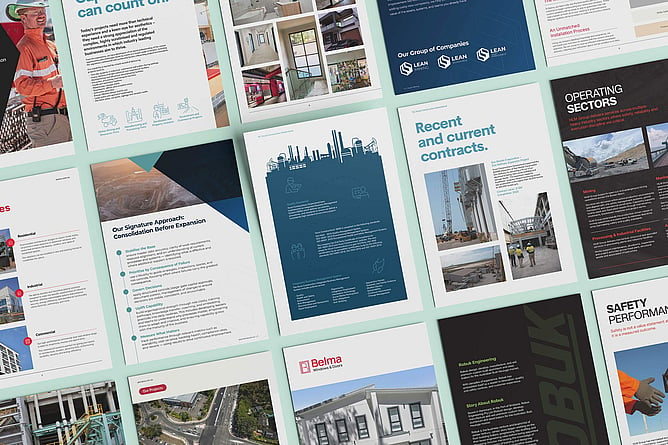
Is your capability statement design underselling your firm’s experience?
Your firm has more established expertise. Your services have evolved. You’re working with larger clients, developing valuable referral relationships and pursuing more significant opportunities.
But the capability statement you send to prospective clients, referral partners and decision-makers still reflects the business you were several years ago. It was built early on, and has since been updated by several different people, with new services and team profiles squeezed into the existing design. The information is technically current, but the document no longer feels aligned with the calibre of work you deliver.
And, it’s underselling the experience and quality of work you deliver.
As one of the first pieces of information someone receives about your firm, if your capability statement looks outdated, is difficult to follow, or doesn’t communicate the depth of your expertise, it can impact this important first impression.
Here’s how to recognise when your company has outgrown its capability statement design, and what needs to change.
Your capability statement should reflect the firm you are today.
For professional services businesses, your capability statement should give prospective clients, referral partners and decision-makers a clear understanding of:
who your firm helps
what you do
where your specialist expertise sits
the experience and credentials behind your services
case studies that showcase results or outcomes
what differentiates your approach
why your firm is well placed to support them
what they should do next to start working with you
When your business was smaller, a simply designed service overview was probably enough. However, your firm has now reached an established level, and you may now have multiple advisers, partners or specialist teams. You may serve particular industries, manage more complex work, or offer a broader range of interconnected services. You also have stronger evidence of your expertise and a proven track record.
If your capability statement hasn’t evolved alongside the business, readers are left to piece the story together themselves.
5 signs your firm has outgrown its capability statement design
1. Your services have changed, but the document design hasn’t
If you’re an accounting firm, you may have expanded your services beyond tax and compliance into business advisory or virtual CFO services.
A mortgage brokerage may begin supporting commercial lending, self-managed super funds or property investors.
A financial advice practice may develop specialist expertise in retirement planning, wealth management or personal insurance.
A law firm may add a new practice area, partner or industry specialisation.
Yet as services are added, they are often inserted wherever there is room. Over time, the capability statement becomes longer without becoming clearer. The firm’s most commercially important services may receive the same weight as minor offerings, while valuable connections between service areas remain invisible.
A capability statement update is an opportunity to reconsider the overall structure so your current offering, and the value behind it, is clear.
Related services can be grouped together, priority services can be featured, and complex information can be supported by clear headings, diagrams or service pathways.
The goal is to help the right readers quickly recognise where your expertise connects with their needs.
2. The document design no longer matches the high quality or level of your work
Your firm may have moved into a different stage of business while its visual presentation and branding got left behind.
Perhaps you are now approaching larger organisations, building relationships with established referral partners or competing for higher-value engagements. If your capability statement still resembles an early DIY document, it can create a disconnect between how your firm presents visually, and the level at which it operates. Design elements like cramped layouts, inconsistent formatting, or generic off-brand visuals can make the firm appear less established and professional than it is.
A well-designed capability statement should express your particular brand while communicating professionalism, care and attention to detail. Its typography, colours, imagery, spacing and layout should work together to make the document feel considered, credible and distinctly yours.
Good design helps the presentation of your firm match the confidence and quality already present in your work.
3. Important information has become difficult to find
As capability statements are updated internally, information often accumulates without a clear hierarchy.
This can easily happen where a team member quickly adds in a new service, someone updates a bio, or credentials, memberships and contact information are placed wherever they fit.
Eventually, the document contains plenty of information, but the reader has to work too hard to understand what matters.
Your clients may already be trying to navigate detailed financial, legal, regulatory or commercial decisions. Your capability statement should reduce that complexity, making it easier for them to understand how you can help and why you’re the right fit to help them.
Clear capability statement design helps readers scan the document and find:
the services relevant to them
the clients, industries or circumstances you support
your team’s qualifications and specialist experience
examples of comparable work or client outcomes
your approach to working with clients and referral partners
the next step for contacting your firm
When the most important information is easy to find, your expertise is easier to recognise, and your firm is easier to choose and recommend.
4. You have better proof than your capability statement shows
As an established firm, you likely have the following to draw from:
relevant client case studies
demonstrated experience across specific sectors
long-standing client and professional referral relationships
expanded qualifications or accreditations
industry memberships
awards or recognition
an experienced multidisciplinary team
testimonials from the kinds of clients you want more of
clear outcomes or examples of past work
Your capability statement should use this proof strategically.
Rather than stating that your firm is experienced or trusted, give readers the evidence to reach that conclusion. Relevant case studies, credentials, client experience and testimonials make your capability more tangible and help distinguish your firm from competitors making similar claims.
For financial, legal and other regulated professional services, this information also needs to be presented carefully and in line with your industry requirements.
A well-considered design creates clarity and credibility while accommodating disclaimers, license details and other required information ( without allowing it to overwhelm the document).
5. Different people are sending different versions
If your team has several versions of the capability statement saved across desktops, shared drives and email threads, the document is no longer doing its job properly.
One version may contain the correct services but an old team profile, while another is using updated branding but outdated contact or licence details. A third may have been tailored for a particular prospect and then accidentally adopted as the firm’s standard document.
This creates extra work, weakens brand consistency and increases the chance of incorrect information being sent, particularly as the team grows and more people become involved in business development.
A professionally updated capability statement gives your team an approved, current master document to work from, so your advisers, partners and business development team can confidently introduce the firm without reconstructing its story for every conversation.
When an opportunity does require tailored content, there is a clear, consistent foundation to begin with, without starting from scratch.
What should change when you update your capability statement design?
Effective professional services capability statement design brings together audience, positioning, information structure, visual presentation and practical use.
1. Reconsider the audience your document is designed for
Start with who will receive the document, and what they need to understand before they can take the next step.
Is it primarily intended for prospective clients? Referral partners? Corporate organisations? Other professional firms? Procurement teams or executive decision-makers?
A capability statement can support several audiences, but its design structure and emphasis should reflect the people most important to your firm’s current growth.
For example, a financial advice or wealth management firm building referral relationships may need to clearly explain its ideal clients, specialist advice areas, referral process and approach to collaboration. An accounting firm may need to show how its compliance, advisory and virtual CFO services support clients at different stages. A consulting firm pursuing larger organisational projects may need more emphasis on methodology, team capacity, sector experience and past performance.
When the audience is clear, decisions about the content and design become much easier.
2. Create a clear information hierarchy
Not every piece of information needs equal visual weight. Your core positioning, priority services and strongest proof should be easy to find. Supporting details can then be organised beneath clear headings or presented through tables, diagrams, timelines and other visual elements.
Strategic capability statement design guides readers through the document in a logical order. It helps them understand who you are, recognise the relevance of your services and build confidence in your expertise without encountering a series of disconnected visual or text blocks.
Update the visual design of your document.
Your capability statement redesign should align with your current brand and work cohesively across every page.
This includes:
Typography
Colour use
Imagery
Page layouts
Headings and subheadings
Icons and supporting graphics
Tables and diagrams
Team profiles
Calls to action
Contact and compliance information
Consistency makes the document easier to navigate while strengthening brand recognition and trust. Just as importantly, the design should give detailed information enough space to remain readable rather than compressing it into the smallest possible number of pages.
Design the capability statement to be practical to use
Your capability statement needs to work in the real world.
It should be easy to share by email, view on screen, and use in meetings or presentations. Your team should know which version to use and have a clear process for reviewing time-sensitive details such as licences, accreditations and key service information.
If particular opportunities require tailored content, the master design should make that easier, without requiring your team to dismantle the entire document each time an opportunity arises.
The result should be a polished business development tool your team can confidently use.
Is the capability statement design the problem, or has your firm outgrown its brand?
Sometimes the capability statement is the only thing that needs attention. As you review your capability statement design, you may realise that your visual identity still feels aligned with the business, and it’s just the document itself that is outdated, inconsistent or no longer structured around your current services. In that case, professional capability statement design can bring everything together within your existing brand.
Sometimes, redesigning the capability document reveals a wider issue. You may realise that your logo, colours or fonts no longer reflect the firm, or your website, presentations, proposals and social media might all look as though they belong to different businesses. Or, you realise your team are creating new materials without clear brand guidelines or templates to follow.
In this case, it’s likely the capability statement design is one visible sign that your firm has outgrown its broader brand system.
A Brand Pack can give your business a stronger and more consistent visual foundation, while also creating the practical collateral your team needs to use day-to-day.
The right solution depends on where the mismatch sits:
| |
|---|---|
| |
Your branding is strong, but your team needs a broader suite of consistent business documents | Capability Statement Design plus supporting collateral or templates |
Your logo and visual identity no longer represent the firm you have become | |
Your website, proposals, presentations and capability statement all look inconsistent |
A short conversation with a capability statement graphic designer can help clarify whether the issue is contained within the capability statement or whether your wider brand needs attention too.
Your firm has already done the growing. Your capability statement should show it.
Outgrowing your capability statement is a good problem to have. It means your business has developed beyond what the original document was designed to communicate.
But once that gap becomes visible, another round of internal edits usually won’t be enough to resolve it.
At Harbrow Creations, we design professional capability statements for established financial advisers, wealth management firms, mortgage brokers, accountants, SMSF specialists, legal practices and specialist consultants across Australia.
We bring clarity and structure to complex information, make the design process straightforward and create a capability statement that reflects the firm you are today.
If your capability statement is part of a broader brand problem, we can also help refresh your visual identity and create a consistent suite of branded materials through our Client-Ready Brand Pack.
Not sure which option is right for your firm? Book a free consult

